Sorption Potential of Piliostigma Reticulatum Biomass Towards Bromophenol Blue Removal from Aqueous Solution
الكلمات المفتاحية:
Kinetics، Adsorption، Bromophenol Blue، Isotherm، Piliostigma reticulatumالملخص
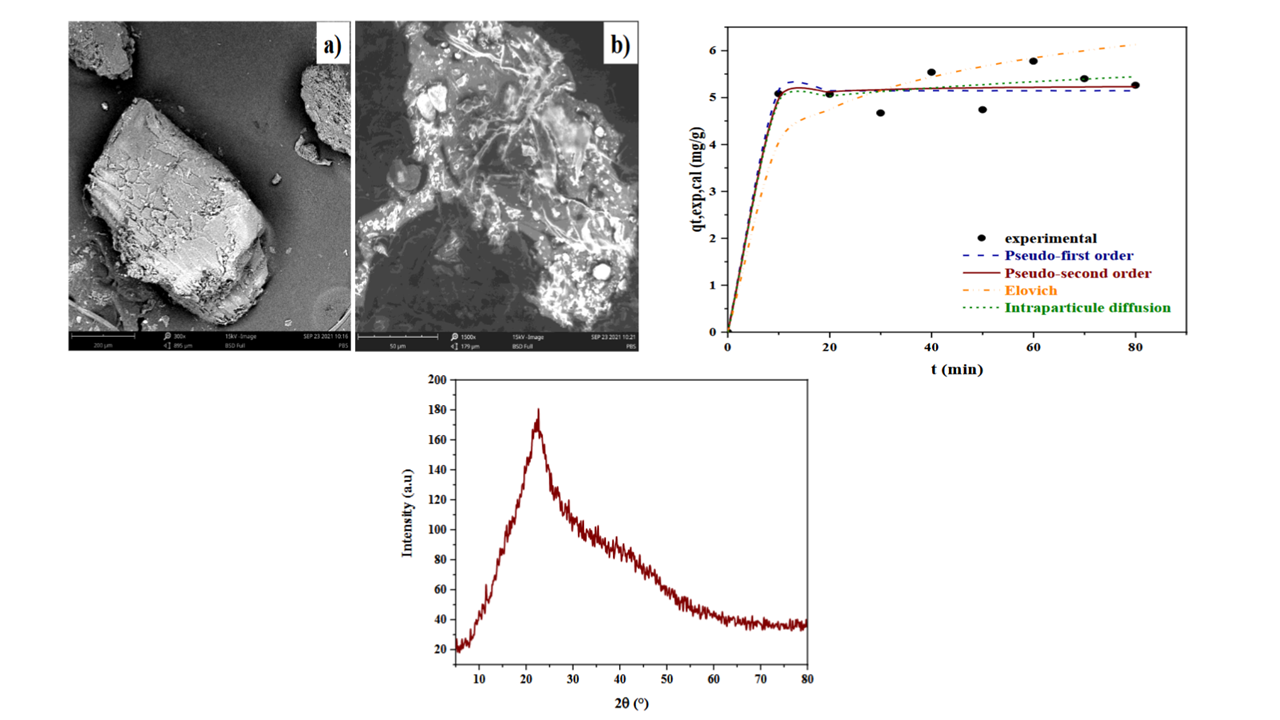
Eco-friendly biomaterial was prepared from piliostigma fruits wild bio-waste. The structure, morphology, chemical composition and crystalline phase of the prepared biosorbent was systematically characterise using some modern techniques like Fourier transform infrared spectroscopy (FTIR), Scanning electron microscopy (SEM), X-ray fluorescence spectrophotometry fundamental parameters (XRS-FP) and X-ray Diffraction (XRD). Piliostigma biomaterial was applied in the removal of Bromophenol Blue (BPB) dye from aqueous solution using batch mode under optimum conditions. The optimum BPB dye adsorbed was 13.7 mg/g at pH 6 for a contact time of 60 min with adsorbent dose of 0.01 and a concentration of 40 mg/L. the adsorptive removal process followed pseudo-second order kinetic with high R2= 0.98, suitable uptake capacity qe= 5.27 mg/g and fitted best the Dubinin Radushkevich equilibrium isotherm model that correlate chemisorption mechanism with low energy E= 0.364 kJ/mol, R2= 0.97 and qe= 14.02 mg/g. these results suggest that prepared biosorbent is a new promising material that have potential applications in the treatment of effluent containing dye pollutant.
التنزيلات
المراجع
[1] P. Szołdra, M. Frąc, and W. Pichór, “Effect of sol composition on the properties of TiO2 powders obtained by the sol-gel method,” Powder Technol., vol. 387, pp. 261–269, 2021.
[2] A. A. El-Zahhar, N. S. Awwad, and E. E. El-Katori, “Removal of bromophenol blue dye from industrial waste water by synthesizing polymer-clay composite,” J. Mol. Liq., vol. 199, pp. 454–461, 2014.
[3] C. Patra, E. Suganya, S. Sivaprakasam, G. Krishnamoorthy, and S. Narayanasamy, “A detailed insight on fabricated porous chitosan in eliminating synthetic anionic dyes from single and multi-adsorptive systems with related studies,” Chemosphere, vol. 281, p. 130706, 2021.
[4] H. Mazaheri, M. Ghaedi, A. Asfaram, and S. Hajati, “Performance of CuS nanoparticle loaded on activated carbon in the adsorption of methylene blue and bromophenol blue dyes in binary aqueous solutions: using ultrasound power and optimization by central composite design,” J. Mol. Liq., vol. 219, pp. 667–676, 2016.
[5] S. Naraginti and Y.-C. Yong, “Enhanced detoxification of p-bromophenol by novel Zr/Ag-TiO2@ rGO ternary composite: Degradation kinetics and phytotoxicity evolution studies,” Ecotoxicol. Environ. Saf., vol. 170, pp. 355–362, 2019.
[6] K. G. Akpomie and J. Conradie, “Efficient synthesis of magnetic nanoparticle-Musa acuminata peel composite for the adsorption of anionic dye,” Arabian Journal of Chemistry, vol. 13, no. 9, pp. 7115–7131, 2020.
[7] T. Sansenya et al., “Hydrothermal synthesis of ZnO photocatalyst for detoxification of anionic azo dyes and antibiotic,” Journal of Physics and Chemistry of Solids, vol. 160, p. 110353, 2022.
[8] K. Alamelu and B. M. J. Ali, “Au nanoparticles decorated sulfonated graphene-TiO2 nanocomposite for sunlight driven photocatalytic degradation of recalcitrant compound,” Solar energy, vol. 211, pp. 1194–1205, 2020.
[9] S. Alahiane, A. Sennaoui, F. Sakr, M. Dinne, S. Qourzal, and A. Assabbane, “Synchronous role of coupled adsorption-photocatalytic degradation of Direct Red 80 with nanocrystalline TiO2-coated non-woven fibres materials in a static batch photoreactor,” Groundw. Sustain. Dev., vol. 11, p. 100396, 2020.
[10] Y. Xiang, M. Gao, T. Shen, G. Cao, B. Zhao, and S. Guo, “Comparative study of three novel organo-clays modified with imidazolium-based gemini surfactant on adsorption for bromophenol blue,” J. Mol. Liq., vol. 286, p. 110928, 2019.
[11] J. Chen, Y. Pu, C. Wang, J. Han, Y. Zhong, and K. Liu, “Synthesis of a novel nanosilica-supported poly β-cyclodextrin sorbent and its properties for the removal of dyes from aqueous solution,” Colloids Surf. A Physicochem. Eng. Asp., vol. 538, pp. 808–817, 2018.
[12] S. Mishra, S. S. Sahoo, A. K. Debnath, K. P. Muthe, N. Das, and P. Parhi, “Cobalt ferrite nanoparticles prepared by microwave hydrothermal synthesis and adsorption efficiency for organic dyes: Isotherms, thermodynamics and kinetic studies,” Advanced Powder Technology, vol. 31, no. 11, pp. 4552–4562, 2020.
[13] A. S. Shair, A. S. A. Dena, and I. M. El-Sherbiny, “Matrix-dispersed PEI-coated SPIONs for fast and efficient removal of anionic dyes from textile wastewater samples: Applications to triphenylmethanes,” Spectrochim. Acta A Mol. Biomol. Spectrosc., vol. 249, p. 119301, 2021.
[14] I. Fatimah, E. Z. Pratiwi, and W. P. Wicaksono, “Synthesis of magnetic nanoparticles using Parkia speciosa Hassk pod extract and photocatalytic activity for Bromophenol blue degradation,” Egypt. J. Aquat. Res., vol. 46, no. 1, pp. 35–40, 2020.
[15] A. C. Khorasani and S. A. Shojaosadati, “Magnetic pectin-Chlorella vulgaris biosorbent for the adsorption of dyes,” J. Environ. Chem. Eng., vol. 7, no. 3, p. 103062, 2019.
[16] W. Xiao et al., “Adsorption of organic dyes from wastewater by metal-doped porous carbon materials,” J. Clean. Prod., vol. 284, p. 124773, 2021.
[17] S. Kocaman, “Removal of methylene blue dye from aqueous solutions by adsorption on levulinic acid-modified natural shells,” Int. J. Phytoremediation, vol. 22, no. 8, pp. 885–895, 2020.
[18] S. De Gisi, G. Lofrano, M. Grassi, and M. Notarnicola, “Characteristics and adsorption capacities of low-cost sorbents for wastewater treatment: A review,” Sustainable Materials and Technologies, vol. 9, pp. 10–40, 2016.
[19] F. Çatlıoğlu et al., “Preparation and application of Fe-modified banana peel in the adsorption of methylene blue: process optimization using response surface methodology,” Environ. Nanotechnol. Monit. Manag., vol. 16, p. 100517, 2021.
[20] B. R. Patra, S. Nanda, A. K. Dalai, and V. Meda, “Slow pyrolysis of agro-food wastes and physicochemical characterization of biofuel products,” Chemosphere, vol. 285, p. 131431, 2021.
[21] S. S. Sahoo, V. K. Vijay, R. Chandra, and H. Kumar, “Production and characterization of biochar produced from slow pyrolysis of pigeon pea stalk and bamboo,” Clean. Eng. Technol., vol. 3, p. 100101, 2021.
[22] S. Naik, V. V Goud, P. K. Rout, K. Jacobson, and A. K. Dalai, “Characterization of Canadian biomass for alternative renewable biofuel,” Renew. Energy, vol. 35, no. 8, pp. 1624–1631, 2010.
[23] V. T. Trinh et al., “Phosphate adsorption by silver nanoparticles-loaded activated carbon derived from tea residue,” Sci. Rep., vol. 10, no. 1, p. 3634, 2020.
[24] P. J. Wibawa, M. Nur, M. Asy’ari, and H. Nur, “SEM, XRD and FTIR analyses of both ultrasonic and heat generated activated carbon black microstructures,” Heliyon, vol. 6, no. 3, 2020.
[25] R. K. Mishra and K. Mohanty, “Pyrolysis of Manilkara zapota seeds over ZSM-5 to produce high-quality bio-oil and chemicals,” Fuel, vol. 280, p. 118594, 2020.
[26] A. Sahoo, S. Kumar, and K. Mohanty, “A comprehensive characterization of non-edible lignocellulosic biomass to elucidate their biofuel production potential,” Biomass Convers. Biorefin., vol. 12, no. 11, pp. 5087–5103, 2022.
[27] H. M. Oo, P. Karin, N. Chollacoop, and K. Hanamura, “Physicochemical characterization of forest and sugarcane leaf combustion’s particulate matters using electron microscopy, EDS, XRD and TGA,” Journal of Environmental Sciences, vol. 99, pp. 296–310, 2021.
[28] X. Yao, H. Zhou, K. Xu, Q. Xu, and L. Li, “Evaluation of the fusion and agglomeration properties of ashes from combustion of biomass, coal and their mixtures and the effects of K2CO3 additives,” Fuel, vol. 255, p. 115829, 2019.
[29] S. M. A. El-Gamal, M. S. Amin, and M. A. Ahmed, “Removal of methyl orange and bromophenol blue dyes from aqueous solution using Sorel’s cement nanoparticles,” J. Environ. Chem. Eng., vol. 3, no. 3, pp. 1702–1712, 2015.
[30] M. Ghaedi, A. M. Ghaedi, E. Negintaji, A. Ansari, A. Vafaei, and M. Rajabi, “Random forest model for removal of bromophenol blue using activated carbon obtained from Astragalus bisulcatus tree,” Journal of Industrial and Engineering Chemistry, vol. 20, no. 4, pp. 1793–1803, 2014.
[31] H. Khoshsang, A. Ghaffarinejad, H. Kazemi, Y. Wang, and H. Arandiyan, “One-pot synthesis of S-doped Fe2O3/C magnetic nanocomposite as an adsorbent for anionic dye removal: equilibrium and kinetic studies,” J. Nanostructure Chem., vol. 8, no. 1, pp. 23–32, 2018.
[32] Y. Dehmani, A. A. Alrashdi, H. Lgaz, T. Lamhasni, S. Abouarnadasse, and I.-M. Chung, “Removal of phenol from aqueous solution by adsorption onto hematite (α-Fe2O3): Mechanism exploration from both experimental and theoretical studies,” Arabian Journal of Chemistry, vol. 13, no. 5, pp. 5474–5486, 2020.
[33] Sali Mouhamadou, Constant Tcheka, Raphael Djakba, Narcisse Dobe, Gilbert Mando, and Massai Harouna, “INVESTIGATION OF Cr (VI) IONS ADSORPTIVE REMOVAL FROM AQUEOUS SOLUTION ONTO TiO2-AC COMPOSITE: NON-LINEAR EQUILIBRIUM MODELING AND KINETICS.,” Int. J. Eng. Sci. Res. Technol., vol. 10, no. 1, pp. 41–54, 2021, doi: 10.29121/ijesrt.v10.i1.2021.3.
[34] W. J. Weber Jr and J. C. Morris, “Kinetics of adsorption on carbon from solution,” Journal of the sanitary engineering division, vol. 89, no. 2, pp. 31–59, 1963.
[35] I. Langmuir, “The adsorption of gases on plane surfaces of glass, mica and platinum.,” J. Am. Chem. Soc., vol. 40, no. 9, pp. 1361–1403, 1918.
[36] H. M. F. Freundlich, “Uber die adsorption in losungen,” 1906.
[37] M. M. Dubinin, “The equation of the characteristic curve of activated charcoal,” in Dokl. Akad. Nauk. SSSR., 1947, pp. 327–329.
[38] M. K. David, U. C. Okoro, K. G. Akpomie, C. Okey, and H. O. Oluwasola, “Thermal and hydrothermal alkaline modification of kaolin for the adsorptive removal of lead (II) ions from aqueous solution,” SN Appl. Sci., vol. 2, no. 6, p. 1134, 2020.
[39] A. Q. Alorabi, M. S. Hassan, and M. Azizi, “Fe3O4-CuO-activated carbon composite as an efficient adsorbent for bromophenol blue dye removal from aqueous solutions,” Arabian Journal of Chemistry, vol. 13, no. 11, pp. 8080–8091, 2020.
[40] K. G. Akpomie, S. Ghosh, M. Gryzenhout, and J. Conradie, “One-pot synthesis of zinc oxide nanoparticles via chemical precipitation for bromophenol blue adsorption and the antifungal activity against filamentous fungi,” Sci. Rep., vol. 11, no. 1, p. 8305, 2021.
[41] S. Dhananasekaran, R. Palanivel, and S. Pappu, “Adsorption of methylene blue, bromophenol blue, and coomassie brilliant blue by α-chitin nanoparticles,” J. Adv. Res., vol. 7, no. 1, pp. 113–124, 2016.
[42] M. Fathy, T. A. Moghny, M. A. Mousa, O. H. Abdelraheem, and A. A. Emam, “Synthesis and study bromophenol blue dye adsorption efficiency of reduced graphene oxide produced by catalytic acid spray (CAS) method,” Journal of the Australian Ceramic Society, vol. 56, no. 2, pp. 567–577, 2020.
[43] M. B. Chabalala, M. Z. Al-Abri, B. B. Mamba, and E. N. Nxumalo, “Mechanistic aspects for the enhanced adsorption of bromophenol blue and atrazine over cyclodextrin modified polyacrylonitrile nanofiber membranes,” Chemical Engineering Research and Design, vol. 169, pp. 19–32, 2021.
[44] J. M. Jabar, I. A. Owokotomo, Y. T. Ayinde, A. M. Alafabusuyi, G. O. Olagunju, and V. O. Mobolaji, “Characterization of prepared eco-friendly biochar from almond (Terminalia catappa L) leaf for sequestration of bromophenol blue (BPB) from aqueous solution,” Carbon Letters, vol. 31, no. 5, pp. 1001–1014, 2021.
[45] B. Naceur, E. Abdelkader, L. Nadjia, and S. Esmahene, “NZF nanoscale particles: Synthesis, characterization and its effective adsorption of bromophenol blue,” Bulletin of Chemical Reaction Engineering & Catalysis, vol. 15, no. 3, pp. 726–742, 2020.
[46] K. G. Akpomie, S. Ghosh, M. Gryzenhout, and J. Conradie, “One-pot synthesis of zinc oxide nanoparticles via chemical precipitation for bromophenol blue adsorption and the antifungal activity against filamentous fungi,” Sci. Rep., vol. 11, no. 1, p. 8305, 2021.
[47] P. R. De Souza, T. M. do Carmo Ribeiro, A. P. Lôbo, M. S. Tokumoto, R. M. De Jesus, and I. P. Lôbo, “Removal of bromophenol blue anionic dye from water using a modified exuviae of Hermetia illucens larvae as biosorbent,” Environ. Monit. Assess., vol. 192, no. 3, p. 197, 2020.
التنزيلات
منشور
خطاب توفر البيانات
Data will be made available upon request from the correspondidng author
الرخصة
الحقوق الفكرية (c) 2026 Sali Mouhamadou, Bouba Talami, Jourdin Gongwala, Djouleyatou Yaya Gue-Yre, Mamat Ousman Bouza, Sadou Dalhatou, Massai Harouna (Author)

هذا العمل مرخص بموجب Creative Commons Attribution-NonCommercial 4.0 International License.

 Articles in this journal are published under the terms and conditions of the Creative Commons Attribution-NonCommercial 4.0 International License.