Process Optimization of Chitosan Adsorption of Methylene Blue Dye from Aqueous Solution Using a Central Composite Design
Keywords:
Chitosan, Methylene Blue, Adsorption, Response Surface, Central Composite DesignAbstract
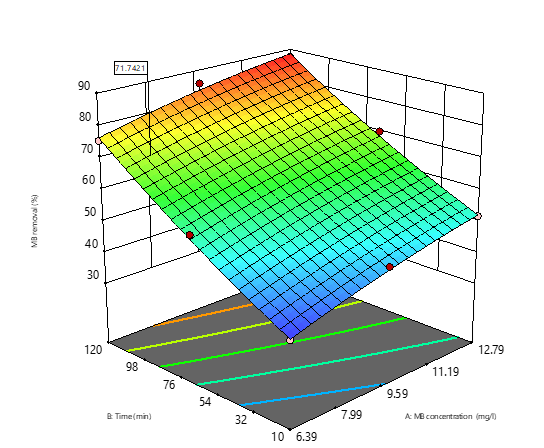
This study investigates the potential of commercial chitosan, a natural and eco-friendly biosorbent, for the removal of methylene blue (MB) dye from synthetic wastewater. Experiments were designed and optimized using central composite design (CCD) to evaluate the interactive effects of initial dye concentration (6.39–12.79 mg/L) and contact time (10–120 min) on removal efficiency. Statistical analysis (ANOVA) revealed that the quadratic model was highly significant (F-value = 128.88, p-value = 0.0002) with an excellent coefficient of determination (R² = 0.9938) and adjusted R² = 0.9861, indicating strong agreement between experimental and predicted values. The derived quadratic equation accurately described the relationship between the variables. Optimization results showed that the maximum MB removal efficiency of 71.74% was achieved at an initial MB concentration of approximately 7.17 mg/L and a contact time of approximately 103.81 min. These findings confirm that chitosan is a promising, low-cost, biodegradable adsorbent for cationic dye removal, offering a sustainable solution for industrial wastewater treatment.
Downloads
References
[1] Md. M. Islam, A. R. Aidid, J. N. Mohshin, H. Mondal, S. Ganguli, and A. K. Chakraborty, “A critical review on textile dye-containing wastewater: Ecotoxicity, health risks, and remediation strategies for environmental safety,” Cleaner Chemical Engineering, vol. 11, p. 100165, Dec. 2025, doi: 10.1016/j.clce.2025.100165.
[2] M. Kumar, V. P. Singh, S. B. Bhat, and R. Kumar, “Environmental risks of textile dyes and photocatalytic materials for sustainable treatment: current status and future directions,” Discover Environment, vol. 3, no. 1, p. 132, Sep. 2025, doi: 10.1007/s44274-025-00337-0.
[3] B. Talami et al., “Efficiency and sustainability for removing organic pollutants in aqueous solution: An innovative composite material,” Chin. J. Chem. Eng., vol. 88, pp. 367–378, Dec. 2025, doi: 10.1016/j.cjche.2025.07.008.
[4] M. Farhan Hanafi and N. Sapawe, “A review on the water problem associate with organic pollutants derived from phenol, methyl orange, and remazol brilliant blue dyes,” Mater. Today Proc., vol. 31, pp. A141–A150, 2020, doi: 10.1016/j.matpr.2021.01.258.
[5] S. Mouhamadou et al., “Synthesis of piliostigma reticulatum decorated TiO2 based composite and its application towards Cr(VI) adsorption and bromophenol blue degradation: Nonlinear kinetics, equilibrium modelling and optimisation photocatalytic parameters,” J. Environ. Chem. Eng., vol. 11, no. 1, p. 109273, Feb. 2023, doi: 10.1016/j.jece.2023.109273.
[6] I. Khan et al., “Review on Methylene Blue: Its Properties, Uses, Toxicity and Photodegradation,” Water (Basel)., vol. 14, no. 2, p. 242, Jan. 2022, doi: 10.3390/w14020242.
[7] D. Dimbo et al., “Methylene blue adsorption from aqueous solution using activated carbon of spathodea campanulata,” Results in Engineering, vol. 21, p. 101910, Mar. 2024, doi: 10.1016/j.rineng.2024.101910.
[8] M. Lehocký, “Environmental Applications of Chitosan Derivatives and Chitosan Composites,” Polymers (Basel)., vol. 17, no. 19, p. 2583, Sep. 2025, doi: 10.3390/polym17192583.
[9] A. Dambuza, P. P. Mokolokolo, M. E. Makhatha, and M. A. Sibeko, “Chitosan-Based Materials as Effective Materials to Remove Pollutants,” Polymers (Basel)., vol. 17, no. 18, p. 2447, Sep. 2025, doi: 10.3390/polym17182447.
[10] F. Zhang, X. Chen, F. Wu, and Y. Ji, “High adsorption capability and selectivity of ZnO nanoparticles for dye removal,” Colloids Surf. A Physicochem. Eng. Asp., vol. 509, pp. 474–483, Nov. 2016, doi: 10.1016/j.colsurfa.2016.09.059.
[11] N. Szpisják-Gulyás, A. N. Al-Tayawi, Zs. H. Horváth, Zs. László, Sz. Kertész, and C. Hodúr, “Methods for experimental design, central composite design and the Box–Behnken design, to optimise operational parameters: A review,” Acta Aliment., vol. 52, no. 4, pp. 521–537, Dec. 2023, doi: 10.1556/066.2023.00235.
[12] X. Zhang, J. Chen, M. Mao, H. Guo, and Y. Dai, “Extraction optimization of the polysaccharide from Adenophorae Radix by central composite design,” Int. J. Biol. Macromol., vol. 67, pp. 318–322, Jun. 2014, doi: 10.1016/j.ijbiomac.2014.03.039.
[13] K. M. Moria, H. Khurshid, M. R. U. Mustafa, A. Alhothali, and O. O. Bamasag, “Application of the Response Surface Methodology (RSM) in the Optimization of Acenaphthene (ACN) Removal from Wastewater by Activated Carbon,” Sustainability, vol. 14, no. 14, p. 8581, Jul. 2022, doi: 10.3390/su14148581.
Downloads
Published
Data Availability Statement
All the data from the research is made available in the article
Issue
Section
Categories
License
Copyright (c) 2026 Ojiabo Kenechukwu Theresa, Ajayi Eshiorenoya David, Nwokoma Patience, Okafor Nicholas Nwankwo (Author)

This work is licensed under a Creative Commons Attribution-NonCommercial 4.0 International License.

 Articles in this journal are published under the terms and conditions of the Creative Commons Attribution-NonCommercial 4.0 International License.